 Mendenhall Glacier Tours
Best Time to Visit Mendenhall Glacier: Month by Month in 2026
The best time to visit Mendenhall Glacier is June through August, when the Visitor Center is on full summer hours, the days run close to eighteen hours long, and humpbacks are feeding in the water between the glacier road and Auke Bay. July is the warmest month of the year in Juneau at 17.8 °C (64.0 °F) average high, and August is the month to pick if you came for bears, because the salmon run at Steep Creek pulls black bears onto the boardwalk within a few yards of visitors. The runner-up window is May and early June, which are the driest months of the year measured in rain days and the peak months for humpbacks. The month most people should think twice about is October, when the tour season winds down, the Visitor Center drops to intermittent hours and the rain is relentless. One thing no month on this page will give you is dry weather, and that single fact should shape your packing more than the temperature does.
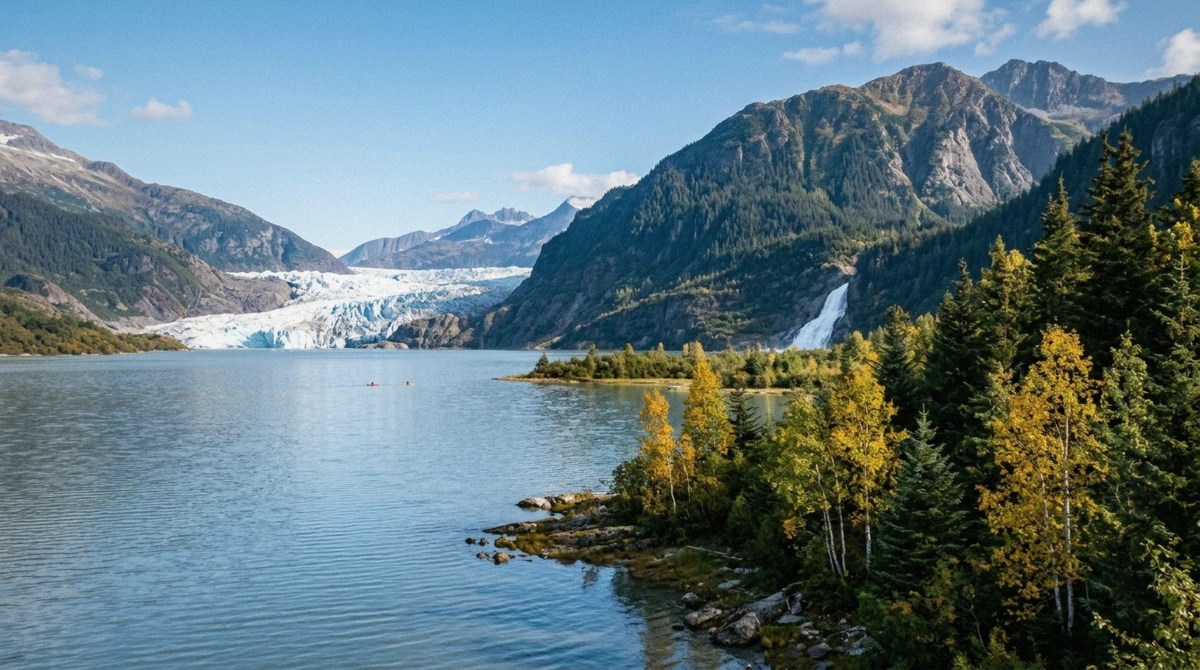
Quick answer The month that beats the rest, and why rain gear is on the list in all twelve
June through August is the best time to visit Mendenhall Glacier. July is the warmest month at 17.8 °C (64.0 °F) average high, daylight peaks at 18 hours 17 minutes around the June solstice, and the Visitor Center runs its full 09:00 to 18:00 schedule from 1 May to 30 September. Pick August if bears are the reason you are coming, and May or June if you want the fewest rain days and the strongest whale odds. Rain is the default in every month, which is why seasonal tours from Juneau run in it rather than around it.
Key takeaways
- July is the warmest month at 17.8 °C (64.0 °F) average high; January is the coldest at 0.6 °C (33.1 °F).
- August into September is peak bear season at Steep Creek, watched from a raised boardwalk a few yards above the fish. What that changes about your day pack is on the what to wear page.
- May and June are the driest months by rain-day count and still wet: rain falls on 16.1 days in May and 19.4 days in August.
- September and October are the wettest months of the year, at 232 mm and 214 mm of rain.
- Winter visits work if you plan around the building: the Visitor Center opens 10:00 to 16:00 on Fridays and Saturdays only from November through March, while the grounds stay open 06:00 to midnight all year.
Seasons at a Glance
Two tables do most of the work on this page. The first is the planning verdict for each month, the second is the raw weather behind those verdicts. Read the Verdict column as a recommendation for a first-time visitor with a normal tolerance for rain, not for a photographer chasing a specific light.
The month-by-month verdict
Crowd levels in this table track the cruise calendar rather than the weather. Juneau's 2026 season opened on 27 April 2026 and the ships keep coming into early October, so the busy months are not simply the warm ones. Wildlife is the axis that separates the summer months from each other: whales dominate May and June, salmon and bears take over from July, and by late September both stories are fading at once.
No month here is a write-off. The grounds and trails are open every day of the year, and the glacier does not stop being worth the trip because the building is shut. What changes month to month is how much of the site is staffed, how many people are on the path in front of you, and what wildlife is doing.
| Month | Wildlife and conditions | Weather | Crowds | Verdict |
|---|---|---|---|---|
| January | Lake frozen, mountain goats on the cliffs | 0.6 °C (33.1 °F) high, heavy snow | Very low | Quiet, very short days |
| February | Ice on the lake, calving warnings possible | 2.1 °C (35.7 °F) high, snow | Very low | Quiet, cold, bring traction |
| March | Snowpack easing, trails still icy | 4.0 °C (39.2 °F) high | Very low | Last of the winter quiet |
| April | Melt underway, first ships late in month | 9.3 °C (48.7 °F) high, driest by volume | Low, rising after 27 April | Shoulder value, tours restarting |
| May | Humpbacks arrive in numbers | 14.2 °C (57.6 °F) high, fewest rain days | Moderate to high | Best value, fewest rain days |
| June | Peak humpbacks, bubble-net feeding starts | 16.9 °C (62.4 °F) high, long light | High | Best overall for whales |
| July | Sockeye and coho reach Steep Creek | 17.8 °C (64.0 °F) high, warmest month | Peak | Best overall |
| August | Peak bear viewing at the boardwalk | 17.2 °C (62.9 °F) high, wetter | Peak | Best month for bears |
| September | Salmon finishing, whales thinning out | 13.4 °C (56.1 °F) high, wettest month | Moderate, falling fast | Wet, quiet, good value |
| October | Season closing, first snow on the peaks | 8.5 °C (47.3 °F) high, 214 mm rain | Low | Skip unless you want solitude |
| November | Winter hours begin at the Visitor Center | 3.5 °C (38.3 °F) high, snow returns | Very low | Locals and photographers only |
| December | Darkest month, grounds still open | 1.5 °C (34.7 °F) high, snow | Very low | Darkest month, grounds open |
Temperatures and rainfall by month
These are typical figures rather than a forecast. Southeast Alaska weather turns fast, and a single day in July can hand you sun, cloud and rain inside four hours. Read the rain-day column before the millimetre column: the number of days it rains matters far more to a visitor with a fixed port call than the volume that falls does.
| Month | Average high | Average low | Rain | Days with measurable rain |
|---|---|---|---|---|
| January | 0.6 °C (33.1 °F) | -4.6 °C (23.8 °F) | 153 mm (6.02 in) | 20.4 |
| February | 2.1 °C (35.7 °F) | -4.1 °C (24.6 °F) | 109 mm (4.31 in) | 16.8 |
| March | 4.0 °C (39.2 °F) | -3.0 °C (26.6 °F) | 93 mm (3.67 in) | 17.8 |
| April | 9.3 °C (48.7 °F) | 0.5 °C (32.9 °F) | 88 mm (3.47 in) | 17.2 |
| May | 14.2 °C (57.6 °F) | 4.6 °C (40.3 °F) | 89 mm (3.51 in) | 16.1 |
| June | 16.9 °C (62.4 °F) | 8.2 °C (46.8 °F) | 97 mm (3.82 in) | 16.7 |
| July | 17.8 °C (64.0 °F) | 10.1 °C (50.1 °F) | 131 mm (5.14 in) | 18.5 |
| August | 17.2 °C (62.9 °F) | 9.5 °C (49.1 °F) | 163 mm (6.41 in) | 19.4 |
| September | 13.4 °C (56.1 °F) | 6.7 °C (44.1 °F) | 232 mm (9.15 in) | 22.3 |
| October | 8.5 °C (47.3 °F) | 2.8 °C (37.1 °F) | 214 mm (8.42 in) | 23.0 |
| November | 3.5 °C (38.3 °F) | -1.6 °C (29.2 °F) | 166 mm (6.54 in) | 20.9 |
| December | 1.5 °C (34.7 °F) | -3.3 °C (25.9 °F) | 166 mm (6.53 in) | 21.1 |
What those numbers actually mean
Every figure in the table above comes from the NOAA NCEI United States Monthly Climate Normals for 1991 to 2020, station USW00025309 at Juneau International Airport, which sits about 5 miles from the Visitor Center. Check the National Weather Service Juneau forecast a few days before you travel, because normals describe three decades, not your Tuesday.
Read across those rows and the shape of the year is obvious. July is the warmest month at 17.8 °C (64.0 °F) and January the coldest at 0.6 °C (33.1 °F) by day. April is the driest month by volume at 88 mm, but it is not the driest by rain days: that title belongs to May at 16.1 days. September and October are the wettest months of the year at 232 mm and 214 mm, and the annual total is 1,701 mm, or 66.99 inches. That is roughly four times what London gets.
This is the single most useful planning fact on the page, so it is worth stating without softening: even in the driest summer month, it rains at Mendenhall Glacier on more than half the days. Rain falls on 16.1 days in May, 16.7 in June, 18.5 in July and 19.4 in August. There is no month you can book to avoid it. What you can do is dress for it, which is covered on the what to wear page, and pick a tour that keeps moving in it rather than one that sits still.
The long trend is worth one line too. Juneau's mean temperature rose 2.5 °F (1.4 °C) between 1941 and 2020, which is the same warming that pushed the glacier back from the lake in November 2025.
Which Month Fits Your Trip
If you want whales more than anything else
go in May or June. Humpbacks are common in Juneau waters from May through September, and May and June are the peak months, with June and July the best for bubble-net feeding.
If you came to see bears
go in August. The sockeye and coho runs at Steep Creek pull black bears to the creek from July into September, and the peak window begins in August and lasts into September.
If you are travelling with young children
go in June or July. The warmest and driest stretch of the year means less time fighting wet layers, and the paved paths near the Visitor Center handle strollers well.
If you are photographing the glacier
go in September, or in winter if you can accept the hours. September is wet but the light is low and long, the crowds thin out through the month, and the grounds are open from 06:00 to midnight.
If you are watching the budget
go in May or late September. Both sit outside the true peak, both still have the Visitor Center staffed under the 1 May to 30 September season, and both trade some wildlife certainty for a quieter path.
Season by Season at Mendenhall Glacier
Spring, April and May: fewest rain days, whales arriving
Spring at Mendenhall is the season nobody plans for and plenty of people accidentally get right. April is the driest month of the year by volume at 88 mm, and May has the fewest days of rain of any month at 16.1. Average highs climb from 9.3 °C (48.7 °F) in April to 14.2 °C (57.6 °F) in May, which is cool enough that you will want a layer under your shell but warm enough for the full trail network.
The wildlife story starts here. Humpbacks are common in Juneau waters from May through September, and ADF&G names May and June as the peak months north and west of Douglas Island. That makes spring the strongest half of the year for a combined outing, and the 5-hour glacier and whale combo from Juneau Tours is built around exactly that pairing, with two full hours at the glacier on either side of the water.
The honest trade-off: early May still has ice and slush on the flat trails, the melt is running hard through the creeks, and the first weeks of the cruise season are when operators are still shaking out their schedules. The 2026 season opened on 27 April 2026, so anything before that date means a much quieter site with far fewer departures.
Summer, June through August: long light, full staffing, peak everything
This is the window most visitors should aim for. Average highs sit between 16.9 °C (62.4 °F) in June and 17.8 °C (64.0 °F) in July, the Visitor Center is open 09:00 to 18:00 seven days a week under its 1 May to 30 September season, and daylight is long enough that a late-afternoon arrival still leaves hours of usable light.
Summer also brings the fullest range of ways to reach the ice. Paddling season is properly open, and the Mendenhall Lake canoe crossing runs with a maximum of ten paddlers across a lake that carries icebergs well into August. The trade-off is people. Juneau caps arrivals at five large ships a day under an agreement with the cruise lines, and figures computed from the 2026 Juneau ship calendar show that cap being reached on 83 separate days of the season. On those days the Visitor Center and the Photo Point path are genuinely busy between roughly 10:00 and 15:00.
August deserves its own note. It is marginally cooler than July at 17.2 °C (62.9 °F) and noticeably wetter, with 163 mm of rain across 19.4 days, but it is the month the bears show up in numbers.
Autumn, September and October: wettest, quietest, cheapest
September is the wettest month of the year at 232 mm across 22.3 rain days, and October is barely behind it at 214 mm across 23.0 days. Average highs fall from 13.4 °C (56.1 °F) to 8.5 °C (47.3 °F). If you dislike being wet, this is not your season and no amount of framing will change that.
What autumn buys is space. Ship traffic thins through September, the last salmon are still in Steep Creek for the first half of the month, and the light through low cloud on the glacier face is the kind photographers travel for. Departures are still running: the Blue Bus shuttle from the cruise terminal works right through the season, and with fewer ships in port the two hours it gives you at the glacier feel considerably longer.
The trade-off beyond the rain is staffing. The fee season and the Visitor Center summer season both end on 30 September, and April and October are described by the Forest Service as intermittent, so the building may or may not be open on the day you arrive. The grounds are not affected.
Winter, November through March: the honest version
Winter at Mendenhall is a real option, and it is nothing like a summer visit. The Visitor Center is open 10:00 to 16:00 on Fridays and Saturdays only from November through March, excluding federal holidays. The grounds and trails stay open 06:00 to midnight, every day, all year, so the glacier itself is never closed to you. Average highs run from 0.6 °C (33.1 °F) in January to 4.0 °C (39.2 °F) in March, and January alone gets 62 cm (24.5 in) of snow.
Daylight is the constraint nobody budgets for. On 21 December 2026 the sun rises at 08:45 and sets at 15:07, giving 6 hours 22 minutes of daylight. That is not a reason to stay home, but it does mean a winter visit is a single planned outing rather than a flexible afternoon. Traction devices for your boots matter more than any other single item.
One safety line belongs here. In February 2025 the Forest Service warned people to keep away from the glacier face after a large crack opened, and a section then calved into the lake. The face is not a place to walk up to in any season, and the state of the ice generally is covered on the ice caves page.
The Wildlife Calendar
Three species drive almost every wildlife question about Mendenhall Glacier, and each one has a different window. Nothing here is a guarantee. Animals are not scheduled, and a good operator will tell you the same thing.
Who is here, and when
The table below is the compact version. Where a species has a genuinely different peak from its presence window, the peak is what you should book around.
| Species | Months present | Peak | Where you see them |
|---|---|---|---|
| Humpback whale | April to November, common May through September | May and June; June and July for bubble-net feeding | Auke Bay and the water off Douglas Island, on a whale-watch boat |
| Black bear | Around the recreation area through summer | August into September | Steep Creek, from the raised boardwalk |
| Sockeye and coho salmon | July through September | August | Steep Creek, visible from the boardwalk |
| Bald eagle | Year round | Salmon months, July to September | Trees along the glacier road and the lake shore |
| Mountain goat | Year round | No distinct peak | The cliffs of Mount Bullard, best with binoculars |
| Orca | Occasional, no reliable season | None published | Open water on a whale-watch trip, rarely |
Whales: May and June are the strongest months
Humpback whales inhabit the northern Inside Passage from April to November and are common in Juneau waters from May through September. Alaska Department of Fish and Game names May and June as the peak months in the water north and west of Douglas Island, and June and July as the best months to see bubble-net feeding, the cooperative hunting behaviour where a group of whales drives a ball of herring to the surface inside a ring of bubbles. In late summer the greatest concentrations of feeding humpbacks in Southeast Alaska are found in Stephens Passage, which is further from town.
Orcas are a different matter. ADF&G frames seeing one near Juneau as being especially lucky, and no sighting-probability figure exists for them. Treat an orca as a bonus, never as a reason to book. What operators can and do control is time on the water: the Dolphin jet boat trip with a money-back whale guarantee puts its promise in writing and still gives you 2 hours 15 minutes at the glacier afterwards.
Federal rules shape what any of this looks like from the deck. It is unlawful to approach within 100 yards (91.4 m) of a humpback in Alaska waters, a rule in force since July 2001, and boats must move at a slow, safe speed near whales. Binoculars are not optional equipment on a whale-watch day.
Bears: August is the month
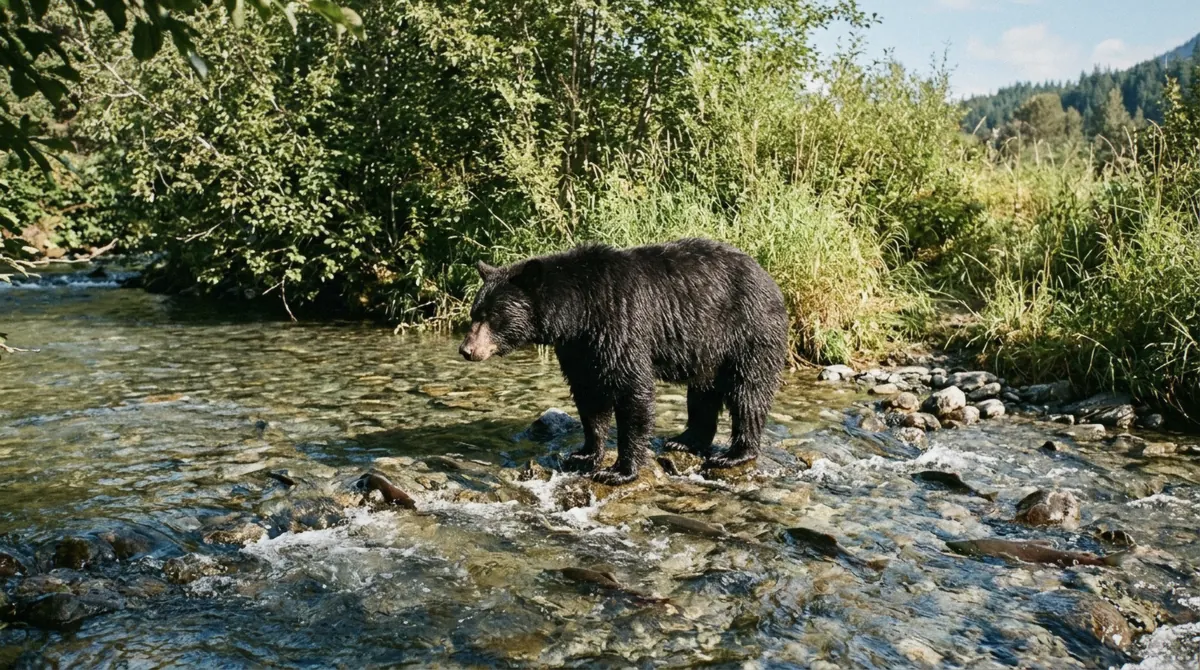
Sockeye and coho salmon both run at Steep Creek from July through September, and the peak bear-viewing window begins in August and lasts into September. About a dozen female and juvenile black bears congregate at Steep Creek during the peak, close enough to the path that the Forest Service posts interpreters on site through the season to manage the traffic in both directions. Brown bears live in the area but avoid heavily used spots.
Viewing is from a 0.03-mile elevated boardwalk with viewing platforms, set a few yards above where the bears fish, and it is wheelchair accessible. Parts of the trail close seasonally during the salmon return, both to improve the viewing and to keep bear movement unblocked, so the loop you find open in August may not be the whole loop.
The rules are short and they are enforced by common sense rather than signage: stay on the trail, give the bears room, do not approach and do not run, keep dogs leashed, and do not eat food or drink flavoured beverages outdoors anywhere near the creek. That last one changes what goes in your day pack, and the what to wear page works through the practical version. The rest of what there is to do around the creek and the lake is on the things to do page.
Daylight, Crowds and the Best Time of Day
Daylight swings by almost twelve hours
On 21 June 2026 the sun rises over Juneau at 03:51 and sets at 22:08, which is 18 hours 17 minutes of daylight, with civil twilight stretching from 02:33 to 23:27. On 21 December 2026 sunrise is 08:45 and sunset 15:07, giving 6 hours 22 minutes. The difference between the two solstices is 11 hours 55 minutes.
In practice that means a June visitor has almost no bad hour. A 19:00 arrival at the Visitor Center in late June leaves three hours of good light and a nearly empty path, because the ships have gone. A December visitor has one usable block in the middle of the day and should treat it as the whole plan.
The crowd pattern is a ship pattern
Juneau's 2026 season opened on 27 April 2026. The city caps large ships at five per day and lower-berth passengers at 16,000 a day from Sunday through Friday and 12,000 on Saturdays, and figures computed from the 2026 Juneau ship calendar show the schedule obeying that cap exactly: no day of the season carries more than five large-ship calls, and 83 days carry the full five.
The weekday pattern from the same calendar is useful if your dates are flexible. Monday averages 4.00 large ships, the busiest day of the week, while Saturday averages 3.25, the quietest, because the Saturday passenger cap is lower. If you can choose, a Saturday in August is meaningfully calmer at the boardwalk than a Monday in August.
Within the day, the pressure is concentrated. Thirty-one percent of 2026 calls dock before 08:00 and 47 percent dock at 12:00 or later, so the site fills through the late morning and stays full into mid-afternoon. Timing your own visit around that is the subject of the tour times page, and the transport side of it is on the getting there page, where the $5 day-use fee published in 2026 is explained in full.
Morning or afternoon
Go early. The first departures of the day, roughly 08:00 to 09:00, put you at the Visitor Center before the bulk of the ship traffic arrives, and in summer that is the difference between having Photo Point to yourself and queueing for the same frame. If you cannot go early, go late: after about 17:00 in June and July the site empties out quickly and there are still four or five hours of light left.
There is one genuine exception. Bears at Steep Creek fish when the fish are moving, which is not a clock-driven behaviour, and the interpreters on site through August will tell you what the creek has been doing that week. If bears are the priority, take the advice on the ground over any schedule.
If the weather turns
Rain almost never cancels anything at Mendenhall. The shuttles, the trolleys and the combos run in it, and the trails stay open. What does cancel is wind, on the water and in the air: whale-watch departures are occasionally pulled for sea state, and helicopter landings are weather-dependent by nature and are the most likely thing on your itinerary to be scrubbed. Operators refund or reschedule rather than fly into cloud.
The practical answer is to put the weather-sensitive item early in your stay if you have more than one day, and to accept that a grey day at the glacier is the normal day at the glacier. To decide whether the guided version is worth the money in the first place, the worth it page takes that apart properly.
If you have one month to choose and no particular species in mind, take July: warmest at 17.8 °C (64.0 °F), longest light, everything staffed and running. If you want bears, move to August and accept the extra rain. If you want whales and the fewest wet days, come in May or June, when rain falls on 16.1 and 16.7 days respectively and humpbacks are at their peak.
September is the value month for anyone who does not mind arriving wet, and winter is a genuine option as long as you build the day around 6 hours 22 minutes of daylight and Friday or Saturday opening hours. Whatever month you land on, the rain gear goes in the bag, and it is worth checking which tours run in your month before you fix the rest of the day around them.
Questions About Timing Your Visit
What is the best month to visit Mendenhall Glacier?
July, for most visitors. It is the warmest month of the year at 17.8 °C (64.0 °F) average high, the Visitor Center is on its full 09:00 to 18:00 summer schedule, the days are close to their longest, and the salmon are beginning to reach Steep Creek. August runs it very close and wins outright if bears are your priority.
When can you see bears at Steep Creek?
Black bears follow the salmon, and the sockeye and coho runs at Steep Creek go from July through September. The peak viewing window begins in August and lasts into September, when about a dozen female and juvenile black bears use the creek. You watch from a raised boardwalk set a few yards above the fish, and parts of the trail close seasonally to keep the bears moving freely.
When is whale season in Juneau?
Humpbacks are in the northern Inside Passage from April to November and are common in Juneau waters from May through September. May and June are the peak months, and June and July are the best months to see bubble-net feeding. Orcas turn up occasionally and Alaska Department of Fish and Game describes seeing one as being especially lucky, so treat them as a bonus. If whales are the point of the day, the most-reviewed glacier and whale trip in Juneau puts a naturalist on board for the water half.
Does it rain every day in Juneau?
Not every day, but more than half of them in every single month. Rain falls on 16.1 days in May, 16.7 in June, 18.5 in July and 19.4 in August, and the annual total is 1,701 mm across the year. September and October are the wettest months at 232 mm and 214 mm. Plan the clothing rather than the calendar around it.
Can you visit Mendenhall Glacier in winter?
Yes. The grounds and trails are open 06:00 to midnight year round, and the frozen lake and snow-covered moraine are a genuinely different sight. The building is the limitation: the Visitor Center is open 10:00 to 16:00 on Fridays and Saturdays only from November through March, excluding federal holidays. Bring traction for your boots and plan around 6 hours 22 minutes of daylight at the December solstice.
How much daylight is there in June?
On 21 June 2026 Juneau gets 18 hours 17 minutes of daylight, sunrise at 03:51 and sunset at 22:08, with civil twilight running from 02:33 to 23:27. That is close to twelve hours more than the December solstice, and it means an evening visit after the ships have sailed is one of the best-value hours of the whole day.
Which days of the week are quietest at the glacier?
Saturdays, by a small but real margin. Juneau's passenger cap is 12,000 on Saturdays against 16,000 on other days, and figures computed from the 2026 Juneau ship calendar show Saturday averaging 3.25 large ships against Monday's 4.00. Going early on any day matters more than the day you choose, but if your dates are flexible, a Saturday morning is the calmest combination.